The Challenge
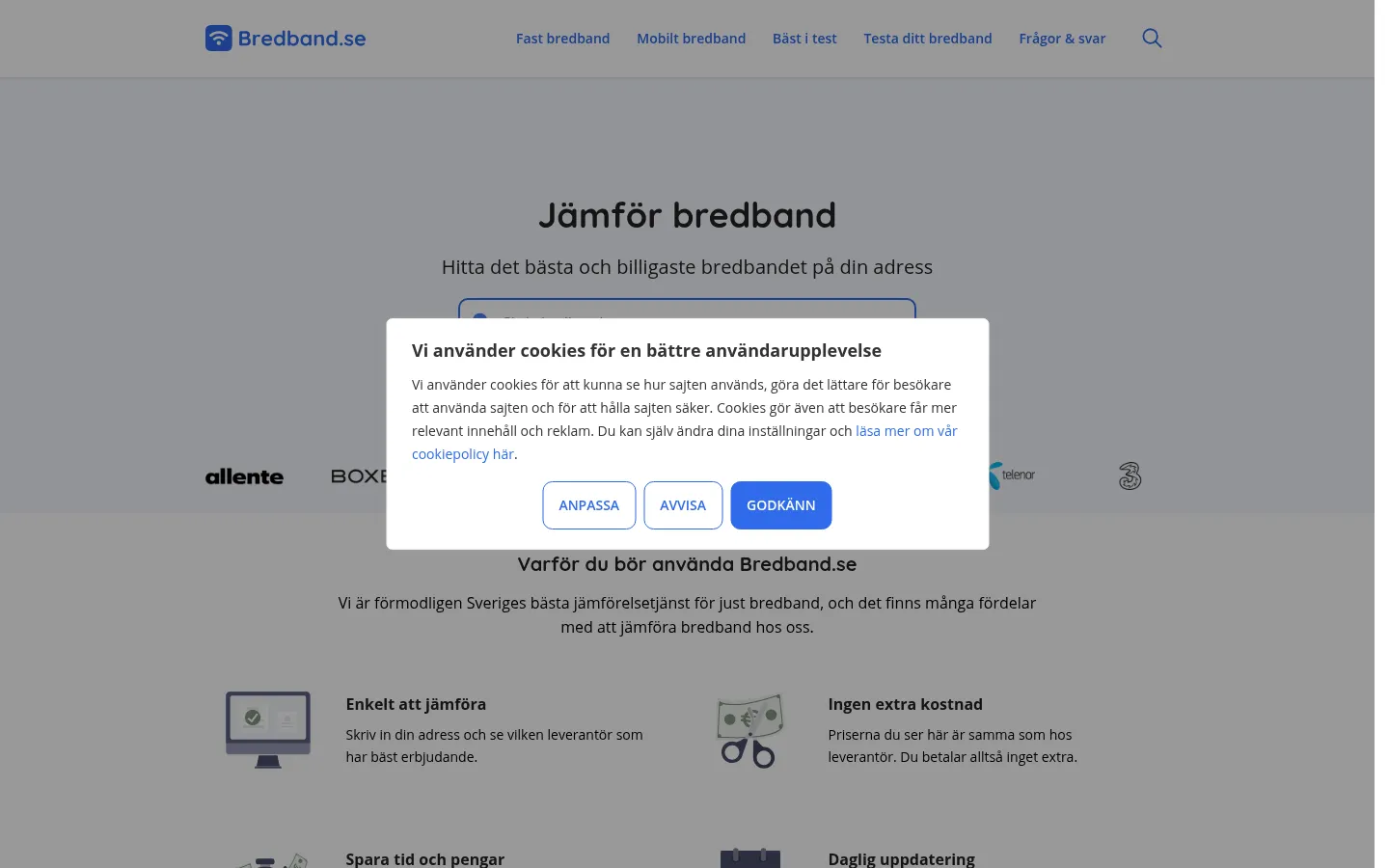
Bredband.se is a Swedish broadband comparison platform helping consumers find the best internet provider for their specific address, budget, and usage requirements. The platform came to Mettevo with a cluster of interconnected problems: the design lacked modern usability standards, the site was not fully responsive on mobile, and the technical performance was insufficient for a comparison platform that needed to handle real-time data queries alongside significant organic search traffic.
The core challenge of broadband comparison website design is that the product being compared is invisible. Unlike a hotel booking or a product purchase, broadband is a service whose quality cannot be experienced before the decision is made. This makes the comparison platform's ability to present accurate, address-specific availability data, genuine speed and price comparisons, and trustworthy provider ratings the entire basis of the user's decision. A platform that compromises on data accuracy or filter precision loses users to a competitor that doesn't.
The Figma-driven redesign process was a specific requirement: the client had invested in a detailed Figma prototype that needed to be translated into a production-grade WordPress implementation with precision. Maintaining the fidelity of the Figma design through the development process — preserving spacing, typography, interaction states, and responsive behaviour — required a development approach that treated the design system as the source of truth throughout the build.
The Strategy
- Figma-to-WordPress implementation with design fidelity — built the production platform directly from the Figma design system, preserving spacing systems, type scales, component states, and responsive breakpoints with pixel-level accuracy across all devices and screen sizes
- Mobile-first responsive redesign — rebuilt the entire comparison interface for smartphone-first interaction, recognising that Swedish broadband research increasingly happens on mobile, particularly at the point of address-specific availability checking when users are at a new property
- ISP filter and comparison UX — implemented an advanced address-based availability check combined with price, speed, and contract length filtering that surfaces relevant options in real time without requiring a page reload, keeping users engaged through the comparison process
- Cloud architecture and performance optimisation — migrated the platform to a cloud infrastructure that eliminated the congestion and performance degradation issues the previous hosting environment created during peak traffic periods, enabling the 50% network capacity improvement the results showed
- Modular CMS for rapid content updates — built a flexible WordPress CMS that allowed the Bredband.se editorial team to add new providers, update pricing data, and publish comparison guides without developer involvement — the architecture that delivered the 30% faster service deployment result
- Nordic SEO architecture — built a Swedish-language keyword-targeted URL structure, implemented structured data for comparison and review content, and developed a content strategy covering broadband speed guides, provider reviews, and address-specific availability explainers for the Swedish market
The Results
Why this matters
Broadband comparison platforms in Scandinavian markets operate in a specific regulatory and consumer context: Swedish consumers are well-informed, privacy-conscious, and quick to identify when a comparison platform prioritises affiliate revenue over genuine user value. A utility comparison website design that earns sustained organic traffic and user trust in this market must be built on genuine data quality and UX clarity — not on the appearance of comparison without the substance.
ISP comparison website design is a performance engineering challenge as much as a UX challenge. A comparison platform whose address availability check takes three seconds to return results loses a measurable share of users at that exact moment — the point of maximum intent in the entire user journey. The platform that returns accurate results fastest earns the conversion. Speed is not a feature in comparison website design — it is the product.
The cloud architecture migration was the decision that unlocked the performance improvements the client needed. A comparison platform that serves real-time availability data to significant concurrent organic traffic cannot rely on shared hosting infrastructure — it needs the elasticity and the query performance that cloud architecture provides. The 50% capacity improvement and the 30% faster service deployment were not design outcomes: they were the results of an infrastructure decision made before a single design component was specified.
If you are building a broadband comparison website development project, a telecom aggregator, or any utility comparison platform for the Nordic market, Bredband.se demonstrates what a combination of Figma-precision design, cloud performance engineering, and filter UX expertise delivers in a data-intensive comparison environment.