The Challenge
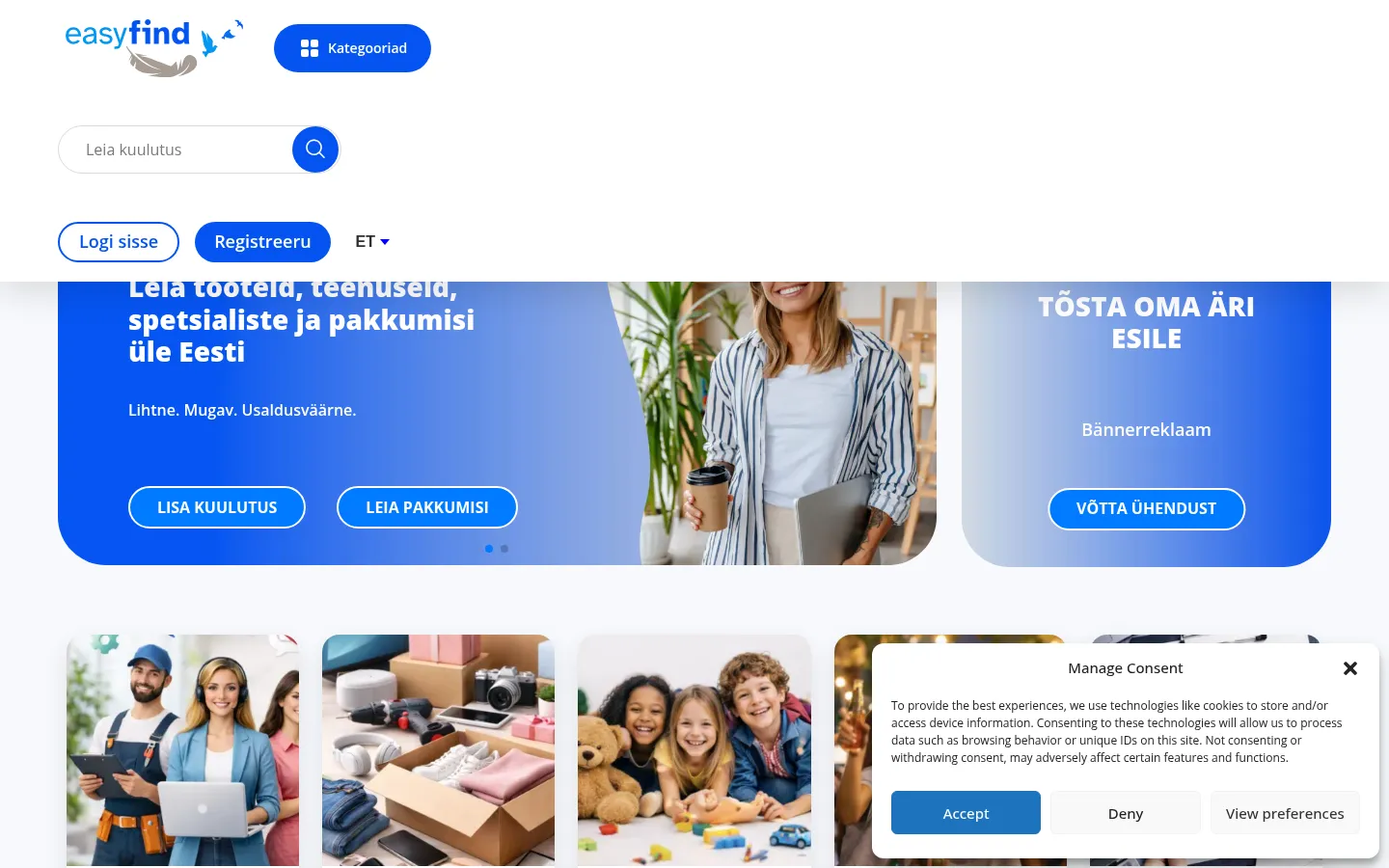
EasyFind.ee is a local services marketplace in Estonia, connecting consumers with vetted service providers across home maintenance, professional services, creative work, and personal care. Two-sided marketplace design is inherently more complex than a standard e-commerce build — the platform must work well for two fundamentally different user groups simultaneously.
The core challenge of marketplace website design is that buyers and sellers have opposing needs. Buyers want the fastest possible path to a relevant, trusted provider. Sellers want maximum visibility for their listings and minimum friction in the listing and enquiry management process. A marketplace that optimises for one at the expense of the other fails commercially.
Trust architecture is a critical additional challenge specific to service marketplaces. Unlike product e-commerce, where quality can be assessed from photography and specifications, service quality is inherently intangible — meaning reviews, verification signals, and platform credibility carry disproportionate weight in the conversion decision.
The Strategy
- HivePress-powered WordPress marketplace — selected and configured HivePress as the marketplace engine for its proven scalability, flexible listing taxonomy, and robust seller management capabilities, customised extensively for EasyFind's specific service categories
- Buyer-facing search and discovery UX — designed a search and filtering system that allows buyers to find relevant providers by service category, location, price range, rating, and availability in a single intuitive interface
- Seller onboarding and listing management — built a streamlined seller registration and listing creation flow that reduces the time from signup to first live listing to under ten minutes, removing the activation friction that kills marketplace supply sides
- Review and trust system — implemented a structured review flow that generates authentic, detailed feedback after service completion, with verification signals that allow buyers to evaluate providers confidently before making contact
- Mobile-first marketplace UX — designed every buyer-facing and seller-facing interaction for smartphone-first use, recognising that local service searches and provider management both happen predominantly on mobile devices
- SEO architecture for category authority — built location and category-based landing pages that capture organic search demand for specific service types and locations, creating a sustainable organic acquisition channel alongside direct platform growth
The Results
Why this matters
Marketplace platforms succeed or fail based on liquidity — the density of buyers and sellers relative to each other. But liquidity starts with product quality: a marketplace that is difficult to use on either side will not retain the supply or demand it needs to reach critical mass. Ecommerce marketplace development for two-sided platforms must prioritise activation rates above all other metrics in the early stage.
Local services marketplace website design is not simply about connecting buyers and sellers — it's about eliminating the trust gap that makes consumers hesitant to book a service from a stranger. Every design decision on EasyFind.ee was evaluated against one criterion: does this increase or decrease buyer confidence at the moment of decision?
The HivePress selection was a deliberate technical decision rather than a default choice. For a marketplace of EasyFind's scope — multiple service categories, location-based filtering, seller self-management, and review systems — a purpose-built marketplace engine outperforms a generic WooCommerce setup in both initial build time and long-term maintainability. Knowing which tool to reach for is a core part of the value Mettevo delivers.
If you're building a local services marketplace website, a multi-vendor platform, or any two-sided marketplace, EasyFind.ee demonstrates the architecture and UX thinking that gets both sides of the market working from day one.