The Challenge
KristineArt is a creator-economy business built around Kristine's artistic practice — offering original art prints, digital illustration downloads, and online art courses that teach her techniques to aspiring artists and creative professionals. Creator businesses spanning physical products, digital products, and education are commercially powerful but structurally challenging: each product type has different purchase motivations, different delivery mechanisms, and different buyer expectations that the ecommerce platform must navigate without creating a fragmented or confusing experience.
The core challenge of art ecommerce website design for a multi-product creator is the coherence problem. A buyer arriving to purchase a digital illustration pack has different needs from one considering enrolling in a six-week online art course, and both have different needs from one wanting to buy a physical art print. A Shopify store not differentiating these product types — through navigation, product page design, and purchase flow — treats fundamentally different buying decisions as identical, serving none of them as well as a purpose-built experience would.
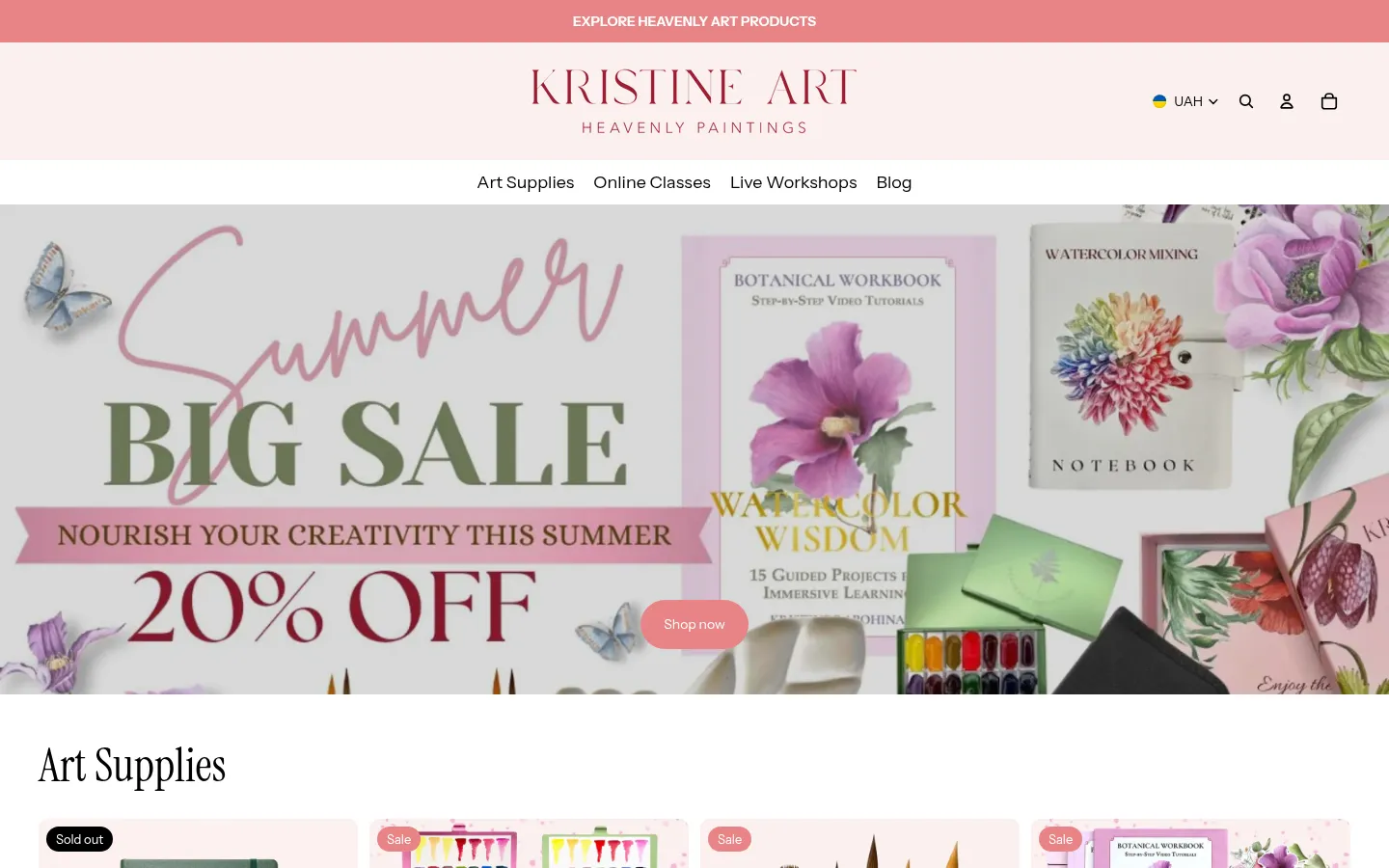
The personal branding dimension was central to the commercial proposition. KristineArt's success depends on the audience's relationship with Kristine as an artist — her aesthetic sensibility, her teaching approach, and her creative voice are the differentiation that commands premium pricing and drives repeat purchases. A Shopify store built on a generic theme would undermine that differentiation by presenting a conventional ecommerce experience rather than an expression of a specific creative identity.
The Strategy
- Multi-product-type Shopify architecture — organised the store into three clearly delineated product areas — physical art prints, digital downloads, and online courses — each with its own collection structure, product page template, and purchase flow appropriate to the specific product type and buyer psychology
- Strong visual hierarchy and product storytelling — designed product pages with a visual hierarchy placing the artwork or course material at the centre, with Kristine's creative context and technique description providing the narrative frame making each product meaningful rather than merely available
- Creator personal brand expression — developed a Shopify design system expressing Kristine's artistic identity through typography, colour palette, and imagery direction — creating a store feeling like an extension of her studio rather than a generic ecommerce environment
- Digital product delivery architecture — configured Shopify's digital product delivery for illustration packs and course materials, with appropriate file management, access control, and post-purchase delivery experience maintaining brand quality through the download moment
- Cross-product discovery design — built cross-sell logic connecting the three product types in commercially logical ways: print buyers surfaced related digital files, digital download buyers shown the course teaching the relevant technique, course students presented the prints and digital assets illustrating covered techniques
- Creator economy SEO and discoverability — implemented structured data for art products, digital creative assets, and online courses, and built a keyword architecture targeting both art purchase queries and art education queries across the full product range
The Results
Why this matters
Creator economy businesses that build their ecommerce presence on generic themes consistently underperform their commercial potential — not because of product quality, but because the platform does not express the creative identity making the creator's work worth a premium. An artist's store looking like every other Shopify store gives buyers no reason to choose the artist's own platform over a marketplace like Etsy. Online art store development expressing the creator's specific aesthetic identity earns the direct relationship and the margin that comes with it.
Art ecommerce website design for creator businesses is fundamentally a brand architecture challenge. The platform must make it obvious, from the first moment of landing, that this is the work of a specific creative voice with a specific aesthetic — not a product catalogue that happens to contain art. Every design decision, from the font choice to the product page layout to the checkout confirmation email, either reinforces or dilutes that creative identity.
The cross-product discovery architecture was the feature most directly increasing average order value and lifetime customer value. A buyer who purchases a digital illustration pack and is not surfaced the course teaching the technique behind those illustrations is a missed commercial opportunity. Building the commercial logic of a creator business — where product types reinforce and extend each other — into the Shopify architecture transformed the store from a product catalogue into a creative ecosystem.
If you are building an art ecommerce website design, a creator economy Shopify store combining physical and digital products, or any online art store needing to express a specific creative identity while maintaining ecommerce conversion performance, KristineArt demonstrates the multi-product architecture and personal brand design that creator businesses need to compete on their own platform rather than a marketplace.