The Challenge
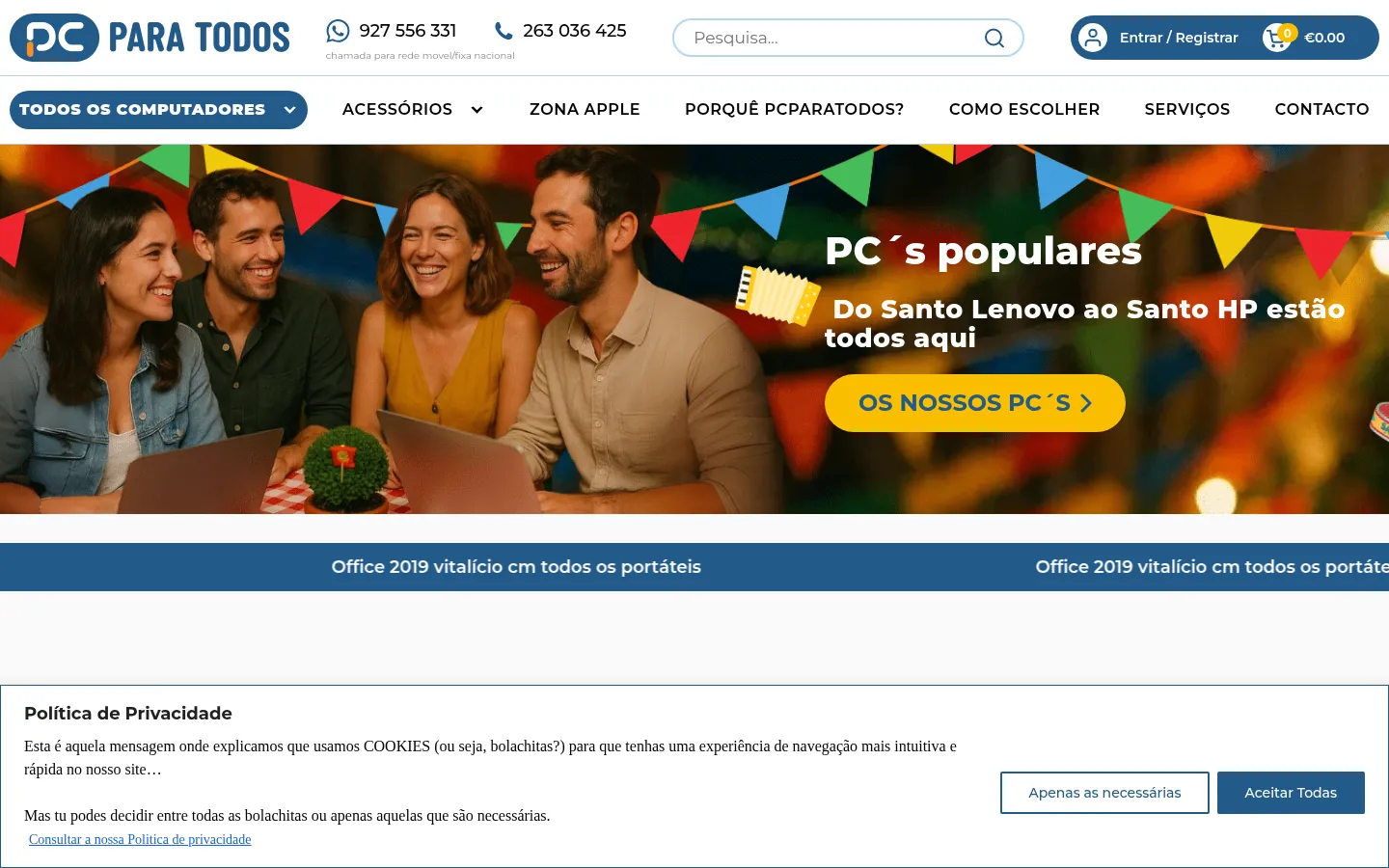
PCParaTodos.pt is a Portuguese consumer electronics and PC components retailer targeting a domestic market that is underserved by local alternatives and typically forced to purchase from international retailers with high shipping costs, long lead times, and no Portuguese-language customer support. The opportunity was clear: build a genuinely competitive Portuguese electronics ecommerce experience that converts the significant share of Portuguese buyers who prefer a local retailer when one is available at a comparable price.
The core challenge of electronics ecommerce website design for a PC components retailer is the specification complexity. Electronics buyers — particularly PC builders — are extremely specification-literate and will immediately identify a product catalogue that lacks the technical detail they need to make a confident purchase decision. A GPU listing without VRAM, power consumption, and PCIe generation; a RAM listing without speed, CAS latency, and compatibility information; a PSU listing without efficiency rating and modular configuration — these are not minor omissions. They are disqualifiers.
The Portuguese language and market context required specific attention. Portuguese search behaviour for electronics differs from English-language markets: localised product naming conventions, Portuguese-language specification terminology, and local VAT display requirements all needed to be built into the platform architecture rather than treated as afterthoughts. A direct translation of an English-language template does not produce a genuinely Portuguese ecommerce experience.
The Strategy
- Specification-first WooCommerce product architecture — built a product page template that surfaces the technical specifications electronics buyers actually use to evaluate purchases — compatibility, performance benchmarks, power requirements, form factor — as primary information rather than footnotes
- PC components catalogue taxonomy — designed a multi-level category structure covering CPUs, GPUs, RAM, storage, PSUs, cases, cooling, and peripherals with the sub-categorisation (socket type, form factor, wattage range) that allows PC builders to find compatible components without cross-referencing external compatibility checkers
- Portuguese-language localisation — implemented full Portuguese-language product content, navigation, checkout flow, and customer communication, with localised VAT display, Portuguese payment method integration, and shipping calculations for mainland Portugal and the islands
- Comparison and compatibility tool — designed a component comparison feature allowing buyers to evaluate multiple SKUs side-by-side on the specifications that determine PC build decisions, reducing the need to leave the platform to validate compatibility
- Value-positioning UX — developed a design language and price presentation strategy that communicated PCParaTodos's competitive pricing clearly without reducing brand credibility — the platform needed to feel trustworthy, not cheap, while making its affordability evident
- Portuguese market SEO architecture — built a Portuguese-language keyword architecture targeting the specific component and electronics search queries the Portuguese market uses, implemented structured data for electronics products, and developed a content strategy covering PC build guides and component comparisons in Portuguese
The Results
Why this matters
Electronics ecommerce in underserved regional markets is won by the first platform to genuinely serve the local buyer rather than adapting an international template. Portuguese electronics buyers who have been purchasing from German or UK retailers because no adequate local alternative existed will switch to a local platform that matches the product depth and specification clarity they have come to expect — provided the Portuguese platform actually delivers that standard rather than just claiming it. WooCommerce electronics store design for the Portuguese market is an opportunity that rewards genuine localisation.
Computer store ecommerce website design in a regional market requires understanding that "local" is not a positioning — it is a promise. A Portuguese electronics buyer choosing PCParaTodos over Amazon.de is making that choice because they expect a genuinely local experience: their language, their pricing conventions, their payment methods, and a catalogue organised around how they actually think about PC components. Delivering that promise is what earns loyalty.
The compatibility-focused catalogue taxonomy was the most commercially important structural decision. PC builders do not shop by brand or by product name — they shop by specification and compatibility. A RAM buyer is not looking for "RAM" — they are looking for DDR5-6000 CL30 compatible with their specific motherboard. A catalogue that does not organise itself around that specificity forces the buyer to do external research, and external research creates the exit event from which many never return.
If you are building a technology products website design for a regional market, a PC components ecommerce platform, or any electronics retailer targeting a non-English-speaking European audience, PCParaTodos.pt demonstrates the localisation depth and catalogue architecture that genuine market entry requires.